Expert Guide · Espresso Machine Technology · Di Pacci Coffee
Espresso Machine Parts & Accessories Explained
Every component of your espresso machine — what it does, why it matters, and how to keep it performing at its best. The complete guide from Di Pacci's service team.
By Di Pacci Service Team·10 min read·Updated 2026
Beginner to AdvancedAll Machine TypesHome & CommercialMaintenance Included
9 bar
Espresso Pressure
93°C
Ideal Brew Temp
8
Key Parts Covered
15 min
Weekly Maintenance
Ever wonder why your espresso tastes amazing one day but weak and sour the next — using the exact same beans? The answer almost always points back to specific espresso machine parts and how well they're performing. Understanding each component transforms you from someone who hopes for a good shot into someone who knows how to produce one consistently.
This guide covers every major espresso machine component — portafilter, group head, steam wand, pump, boiler, and more — explaining what each part does, how it affects your cup, and what to do when something goes wrong. Whether you own a beginner machine or a high-end dual boiler, these fundamentals apply to every espresso machine ever made.
Every espresso machine — from a $499 entry-level unit to a $6,000 dual boiler — contains these fundamental components. Understanding what each does is the foundation of great espresso.
🔩Portafilter
The handle you fill with ground coffee. Locks into the group head to create a pressurised seal for extraction.
🧺Filter Basket
The metal cup inside the portafilter that holds your coffee grounds. Determines crema quality and extraction control.
🚿Group Head
The central hub where portafilter locks in. Distributes pressurised hot water evenly across the coffee puck.
💨Steam Wand
Creates microfoam for milk-based drinks. Injects steam and air into milk to produce silky, textured foam.
⚡Pump
Generates the 9-bar pressure needed for true espresso extraction. The mechanical heart of the machine.
🔥Boiler
Heats and maintains water at the precise 90–96°C needed for optimal espresso extraction.
🌡️PID Controller
Digital temperature regulator. Maintains boiler temperature to within ±1°C for consistent shot-to-shot results.
⭕Group Head Gasket
The rubber seal inside the group head. Creates a watertight lock between portafilter and machine during extraction.
02 · Portafilter & Filter Basket
The Portafilter & Basket: Your Coffee's First Stop
The most-touched part of your espresso routine — and one of the most impactful on flavour.
The portafilter is the weighted handle you fill with ground coffee and lock into the machine. Its primary job is to create a perfect pressurised seal with the group head. That weight isn't cosmetic — it keeps the portafilter hot, which is critical. A cold portafilter cools your brew water on contact, dropping temperatures below the extraction window and producing sour, underdeveloped espresso.
Inside the portafilter sits the filter basket — the small metal cup that holds your grounds. Despite its size, the basket has a profound effect on your final shot. There are two main types:
🔒 Pressurised (Single-Wall) Basket
Has a single small exit hole. Creates foamy crema even if your grind isn't perfect. Ideal for beginners and pre-ground coffee — forgiving and consistent.
⚙️ Non-Pressurised (Double-Wall) Basket
Has hundreds of tiny holes. Requires a quality grinder and precise technique, but produces a true, rich crema and far more flavour control. The barista's choice.
Pro Tip — Upgrade Path
If you've invested in a quality burr grinder and want to unlock more flavour, upgrading from a pressurised to a non-pressurised basket is the single highest-impact accessory upgrade available for most home machines. Compatible baskets for popular brands are available at Di Pacci →
Portafilter size matters: A 58mm portafilter is the commercial café standard. It offers better heat retention and extraction evenness than 54mm or 51mm designs. When choosing a machine, the portafilter size is a meaningful quality indicator.
03 · Group Head
The Group Head: Your Coffee's "Shower"
The central hub of your espresso machine — and the source of the most common extraction problems.
When you lock your portafilter into the machine, you're connecting it to the group head — the metal hub on the front of the machine where all extraction happens. Think of it as a sophisticated shower head for your coffee. Its job is to take hot, pressurised water from inside the machine and distribute it perfectly evenly across the coffee puck.
The key component is a dispersion screen — a metal plate with hundreds of tiny holes on the underside of the group head. If water can't flow evenly through this screen, it drills rivers through your coffee puck. This is called channelling — one of the most common causes of inconsistent espresso. Channelled water means some grounds are over-extracted (bitter) while others are under-extracted (sour and weak), in the same shot.
The E61 Group Head — the gold standard
Many intermediate and prosumer machines feature an E61 group head — a design originally created by Faema in 1961 and still widely used today. The E61 pre-infuses coffee grounds with low-pressure water before full extraction begins, producing more even saturation and a more balanced shot. It also thermosiphons hot water continuously through the group head between shots, keeping it at a stable brewing temperature.
If you see "E61" in a machine's specs — Rocket Appartamento, ECM Mechanika, Profitec, Lelit — it's a meaningful quality indicator.
The gasket: If water leaks around the portafilter during a shot, your group head gasket is worn — a rubber ring that creates the seal. This is one of the most common espresso machine repairs. It's inexpensive and easy to replace. Di Pacci's service team can do it in-store, or we stock replacement gaskets for most brands.
04 · Steam Wand
The Steam Wand: Microfoam Explained
The component that separates an espresso from a flat white. Here's how it works and how to use it correctly.
The steam wand taps into the same boiler that heats your brew water, but uses built-up steam pressure. Its purpose isn't simply to heat milk — it injects the milk with steam and air simultaneously to create microfoam: a velvety, paint-like texture that integrates with espresso to make café-quality flat whites, lattes, and cappuccinos.
Creating perfect microfoam is a two-step technique. First, you stretch the milk: keep the wand tip just at the surface with the jug angled slightly, creating a gentle hissing sound as you introduce air and volume. Once the milk has grown slightly, submerge the tip and angle the jug to create a swirling whirlpool. This motion breaks down large bubbles into uniform, fine-grained foam — giving you the silky texture that pours beautifully.
📐Tip Position
Just below the surface to stretch, then submerged to swirl. Angle the jug 30–45° for best whirlpool effect.
🌡️Target Temperature
Steam to 60–65°C (140–150°F). Too hot and the milk proteins denature, ruining texture and sweetness. Use a clip-on thermometer.
🧹Clean Immediately
Milk proteins cook onto hot metal in seconds. Wipe with a damp cloth and purge steam after every single use — no exceptions.
⚠️ Important — Wand Hygiene
A blocked steam wand tip is one of the most common service issues. If your steam feels weak or irregular, the tip holes are blocked with dried milk. Soak the tip in cold water for 20 minutes, then use a pin to clear each hole. Di Pacci stocks replacement steam wand tips and nozzles for most machines.
05 · The Pump
The Pump: Why 9 Bar Matters
The mechanical heart of every espresso machine — and the reason espresso tastes like nothing else.
The pump is the component hidden inside the casing that creates the intense pressure needed to force hot water through finely-ground, tightly-packed coffee. This isn't a gentle push — to be classified as true espresso, water must be forced through at around 9 bars of pressure. For perspective: a car tyre is inflated to 2–3 bar. Your espresso machine generates 3–4 times that force to extract flavour.
Without sufficient pressure, water moves through the grounds too quickly, failing to pull the sweet, complex compounds that define great espresso. The result is a watery, sour, under-extracted shot. Importantly, the most common cause of "low pressure" shots isn't a failing pump — it's a grind that's too coarse, offering insufficient resistance to the pressurised water.
⚡ Vibratory Pump (Home Machines)
A small, rapidly pulsing piston that builds pressure in bursts. Compact, effective, and affordable — the standard in most home espresso machines. The source of the characteristic buzzing sound during extraction.
🔄 Rotary Pump (Commercial / Prosumer)
A heavier motor-driven pump that delivers constant, stable pressure. Significantly quieter than vibratory pumps, produces more consistent extraction, and lasts longer. Found in prosumer and commercial machines ($1,500+).
Pump pressure setting: Most home machines are pre-set to 9 bar at the factory. Some prosumer machines have an adjustable OPV (over-pressure valve) that can be set between 6–9 bar. Lower pressures (6–8 bar) are increasingly preferred for filter roasts and modern espresso styles. Di Pacci's service team can adjust OPV settings in-store.
06 · Boiler Types
Single vs Dual Boiler: Which Do You Need?
The boiler controls temperature — the single most important flavour variable in espresso. Here's how the three main boiler configurations differ.
The boiler heats and maintains water at the precise brewing temperature — typically 90–96°C (195–205°F). Too cool: sour, underdeveloped espresso. Too hot: harsh, bitter, burnt. Temperature stability is everything, which is why boiler design is one of the most meaningful differentiators between espresso machines at different price points.
Boiler Type
Brew & Steam Simultaneous?
Temperature Stability
Typical Price Range
Best For
Single Boiler
✗ Switch between functions
Good with PID
$400 – $1,500
Home use, 1–2 drinks at a time
Heat Exchanger (HX)
✓ Simultaneously
Very good
$1,500 – $4,000
Home enthusiasts, small cafés
Dual Boiler
✓ Simultaneously
Excellent — independent control
$3,000 – $8,000+
Serious home use, cafés
🎯 Key Feature — PID Controller
A PID (Proportional-Integral-Derivative) controller is the digital brain that manages boiler temperature. It makes tiny, continuous adjustments to keep the water temperature stable to within ±0.5–1°C, shot after shot. Without a PID, boiler temperature can drift several degrees between shots — directly impacting flavour consistency. If you're choosing between two machines at a similar price, the one with PID wins every time.
Not every accessory is worth buying. These are the ones that genuinely improve your espresso — ranked by impact on cup quality.
1
Burr Grinder
The single highest-impact accessory for espresso quality. Consistent particle size is essential for even extraction — no machine can compensate for an inconsistent grind. A quality burr grinder makes a $400 machine produce better espresso than a $1,000 machine with pre-ground coffee.
Highest Impact
2
Precision Tamper (58mm)
A flat, calibrated tamper that matches your basket size perfectly. Even tamping creates an even coffee puck — critical for preventing channelling. Calibrated tampers (set to a specific pressure, e.g. 10kg) remove inconsistency entirely.
High Impact
3
Coffee Scale (0.1g Accuracy)
Espresso is a ratio — typically 1:2 (18g in, 36g out). A scale accurate to 0.1g lets you dial in both dose and yield for repeatable results. Without a scale, you're essentially guessing every shot.
High Impact
4
WDT Tool (Distribution Tool)
A needle-tipped tool used to stir and distribute ground coffee in the basket before tamping. Breaks up clumps and ensures even density across the puck — directly reducing channelling risk.
Medium–High Impact
5
Milk Thermometer
A clip-on or probe thermometer lets you steam milk to exactly 60–65°C every time. Avoids the two most common milk mistakes: under-heated (no sweetness) and over-heated (scalded, flat texture).
Medium Impact
6
Knock Box
A container for spent coffee pucks with a rubber bar to knock against. Keeps your bench clean and protects your portafilter from impact damage. Small but genuinely useful for daily workflow.
Workflow
7
Portafilter Dosing Funnel
A collar that sits on top of the portafilter basket to catch stray grinds during dosing. Reduces waste and keeps the bench cleaner. More useful than it sounds for daily use.
Workflow
8
Shower Screen Replacement
The dispersion screen inside the group head can be upgraded on many machines. A better screen (e.g. IMS or VST) distributes water more evenly, reducing channelling and improving extraction quality — especially noticeable on filter roasts.
Consistent maintenance is the difference between a machine that lasts 15 years and one that fails at 3. Here's the full schedule.
Backflushing: using a blind basket and group head cleaner to dissolve coffee oils from the group head — the most impactful weekly maintenance task.
D
Daily: Rinse & Purge
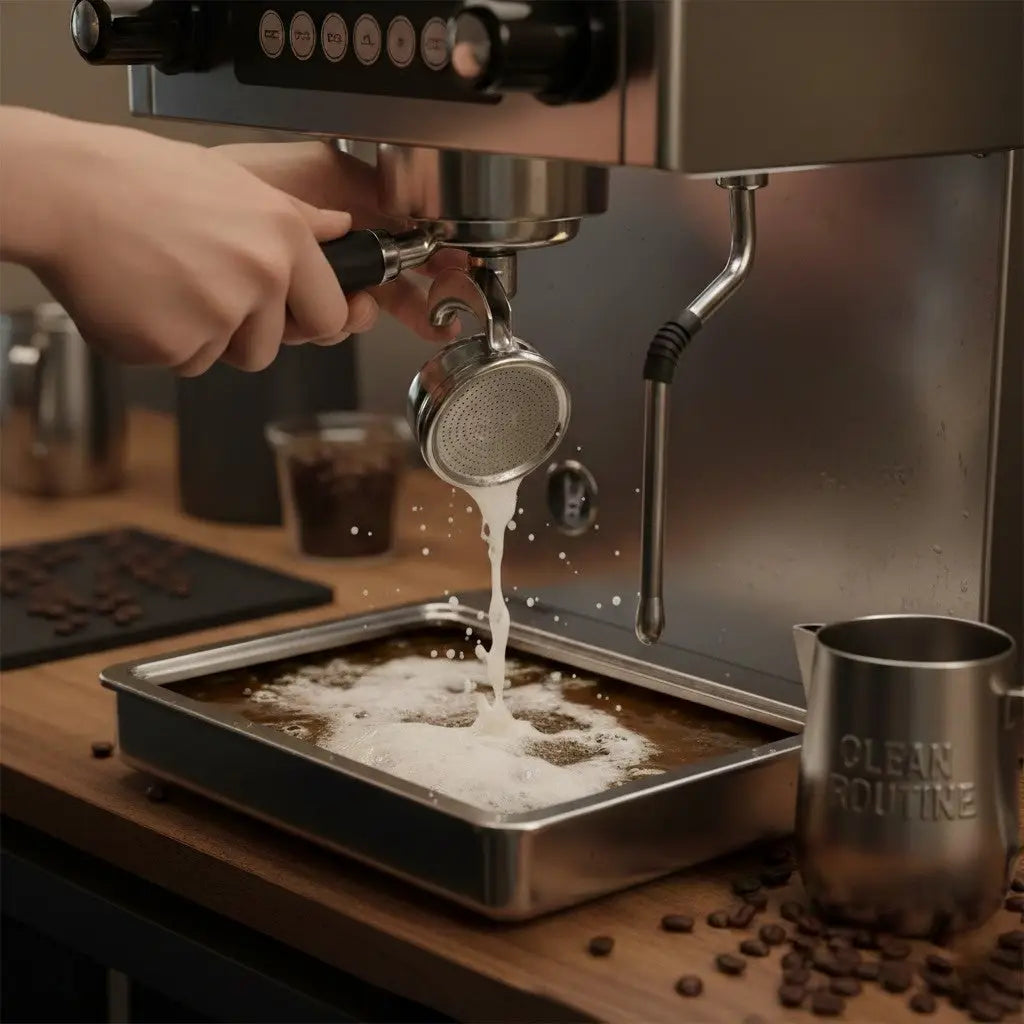
After your last shot, run a short shot of water through the group head (no portafilter) to flush loose grounds. Wipe the group head with a brush. Purge and wipe the steam wand after every use. Takes 2 minutes.
W
Weekly: Backflush the Group Head
Swap in a blind basket (no holes), add a small amount of group head cleaner (e.g. Cafiza), and run several 10-second brew cycles. This forces cleaning solution back through the group head solenoid and shower screen, dissolving rancid coffee oils. The single most impactful maintenance task for flavour.
W
Weekly: Soak the Shower Screen & Basket
Remove the shower screen and filter basket. Soak overnight in a diluted solution of group head cleaner or espresso machine detergent. This removes coffee oils that can't be dissolved by backflushing alone.
M
Monthly: Check & Replace the Gasket
Inspect the group head gasket for cracks or deformation. If your portafilter leaks during extraction or requires extra force to lock, the gasket needs replacing. An inexpensive part that most home users can replace themselves in 10 minutes.
3M
Every 3 Months: Descale the Boiler
Run a descaling solution (citric acid or commercial descaler) through the machine to dissolve mineral scale buildup in the boiler and pipes. Scale insulates the heating element, increases energy use, and causes temperature instability. Frequency depends on your water hardness — more often in hard water areas.
1Y
Annual: Full Service
A professional annual service by Di Pacci's in-house technicians includes: replacement of all seals and gaskets, inspection of pump pressure, boiler descale, lubrication of moving parts, and full calibration. Keeps your machine performing as new for 10–15 years.
Di Pacci service: Our in-house service team handles all major brands — Rocket, ECM, Profitec, Rancilio, La Marzocco, Breville, and more. All parts stocked, most repairs completed same-day. Book a service appointment →
09 · Troubleshooting
Common Espresso Problems & Their Causes
Most espresso problems have a mechanical explanation. Here's how to diagnose the most common issues before calling for service.
Symptom
Most Likely Cause
Fix
Sour, weak shot
Under-extraction — grind too coarse, temp too low, or short shot time
Grind finer, check boiler temperature, extend shot time to 25–30 sec
Bitter, harsh shot
Over-extraction — grind too fine, temp too high, or long shot time
Grind coarser, lower brew temperature, shorten shot time
Water leaking around portafilter
Worn group head gasket
Replace gasket — inexpensive and easy. Di Pacci stocks gaskets for all major brands
Uneven, channelled extraction
Uneven tamp, clumped grounds, or clogged shower screen
Use WDT tool before tamping, upgrade tamper, clean shower screen weekly
Weak or no steam
Blocked steam wand tip, or insufficient boiler pressure
Clear tip holes with a pin; if pressure is low, check for scale buildup — descale
Machine takes too long to heat
Scale buildup on heating element insulating the boiler
Descale the machine — frequency depends on water hardness in your area
Shot runs too fast (<20 sec)
Grind too coarse, under-dosed, or uneven tamp
Grind finer, increase dose by 0.5–1g, ensure level tamp
No crema / pale crema
Stale beans, pressurised basket at capacity, or under-extraction
Use fresher beans (roasted within 2–4 weeks), upgrade to non-pressurised basket
Still not sure? Di Pacci's service team diagnoses machines in-store at all 5 locations. Bring your machine in or call (02) 9758 0760 — we'll tell you exactly what's wrong and what it'll cost to fix before you commit.
10 · FAQ
Frequently Asked Questions — Espresso Machine Parts & Accessories
The most commonly replaced parts are the group head gasket (every 12–18 months), the shower screen (annually or when clogged), and the steam wand O-rings and tip. Pump and boiler components can also wear over time, but typically last 5–10+ years with proper maintenance. Di Pacci stocks replacement parts for all major brands.
A pressurised basket has a single exit hole and builds pressure internally to produce crema even with coarse or pre-ground coffee — ideal for beginners. A non-pressurised basket has hundreds of holes and requires a precise grind and tamp, but produces superior crema and gives experienced users far more control over flavour extraction.
For home use, once a week with group head cleaner (e.g. Cafiza or Puly Caff) is standard. For higher-volume use (more than 5 shots/day), twice a week is recommended. Daily backflushing with water only (no cleaner) is also beneficial. Consistent backflushing is the single most impactful maintenance task for cup quality.
Channelling occurs when pressurised water finds a path of least resistance through the coffee puck — drilling narrow channels instead of flowing evenly. The result is simultaneous over- and under-extraction in the same shot. Prevent it with: even grinding distribution (use a WDT tool), level tamping with a calibrated tamper, a clean shower screen, and ensuring your dose fills the basket appropriately.
A PID (Proportional-Integral-Derivative) controller is a digital temperature regulator that continuously monitors and adjusts boiler temperature to within ±0.5–1°C. Without a PID, boiler temperature drifts over time and between shots — impacting flavour consistency. Machines with PID allow you to set an exact brew temperature and hold it shot after shot.
A single boiler uses one heating tank for both brewing and steaming — you switch between functions and wait for temperature to change. A dual boiler has two separate circuits: one held at brew temperature and one at steam temperature simultaneously. This means you can pull a shot and steam milk at the same time — the same workflow used in commercial café machines.
Signs of pump failure include: shots running significantly faster than usual (low pressure), unusual grinding or buzzing sounds that are louder or different than normal, or an inability to reach 9 bar on a pressure gauge. Note that the most common cause of fast shots is grind size — eliminate that variable first before suspecting the pump. Di Pacci's service team can measure pump pressure in-store.
In order of impact: (1) a quality burr grinder — the single biggest upgrade available; (2) a precision tamper matched to your basket size; (3) a coffee scale accurate to 0.1g; (4) a WDT distribution tool; (5) a milk thermometer. These five accessories will transform the consistency of home espresso more than any machine upgrade.
The E61 group head is a design created by Faema in 1961 that remains widely used in prosumer machines (Rocket, ECM, Profitec, Lelit). It uses thermosiphon circulation to keep the group head at stable brewing temperature between shots, and incorporates a pre-infusion stage that gently wets grounds before full pressure extraction — producing more even saturation and a more balanced shot. Seeing "E61" in specs is a meaningful quality indicator.
Di Pacci stocks a comprehensive range of espresso machine accessories, replacement parts, and cleaning supplies across 5 stores in Sydney, Melbourne, Perth, Port Macquarie, and Queensland — plus Australia-wide shipping. Browse the accessories range online → or call (02) 9758 0760 to check availability for a specific part.
Di Pacci Coffee · Australia's Largest Coffee Machine Specialist
Parts, Service & Expert Advice
Whether you need a replacement gasket, a full machine service, or help choosing your next machine — Di Pacci's team is here in-store and on the phone.