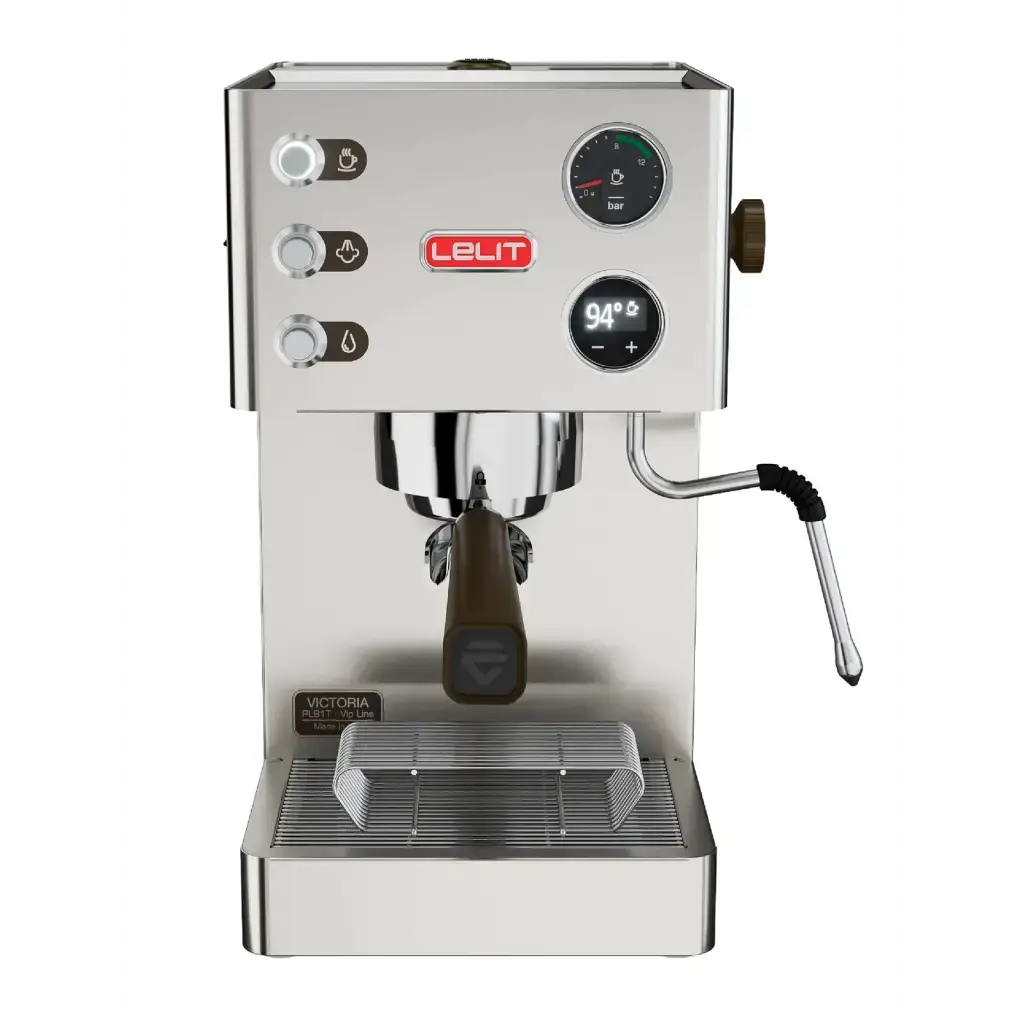
Best Lelit Espresso Machines for Home Baristas in 2026
Have you ever wondered why the espresso you make at home feels weak or bitter compared to the one you get at a coffee shop? Stable temperature control and steady high pressure are two important things that most consumer devices don't have. You're producing strong coffee, not real espresso, without them.
Lelit espresso machines are best at this. These prosumer machines made in Italy give your kitchen café-quality performance without the high price or space.
Quick Guide: How to Choose the Right Lelit Machine for You
-
Lelit Anna/Anita: Best for people who are new to coffee or just drink espresso ($600–$900)
-
Lelit Mara X: The best choice for latte enthusiasts who want things to go quickly and smoothly ($1,600–$2,000)
-
Lelit Bianca: Best for people who want the most control ($2,800–$3,200)
Why Temperature Stability is Important: Learning About PID Control
The most common reason why home espresso tastes different every time is that the temperature is not always the same. Basic machines can change the temperature of your coffee by 10 to 15 degrees Fahrenheit between shots, making it taste sour one day and bitter the next.
PID (Proportional-Integral-Derivative) controllers are what Lelit machines use to fix this. It's like cruise control for the temperature of the water. A PID doesn't turn the heat on and off in harsh cycles; instead, it makes little adjustments all the time to keep the temperature within 1–2°F.
This steadiness is what makes espresso that tastes great every time. It turns brewing from a guessing game into a predictable procedure where you can set your perfect shot and make it every morning.
Why Your Grinder Is More Important Than Your Machine
A $2,000 espresso machine with a $50 blade grinder will not brew good coffee, which is something that many beginners don't know. A $600 machine with a good $400 burr grinder, on the other hand, can make great results.
Espresso needs very fine, even grinds. Blade grinders make particles that aren't always the same size, such fine dust and big chunks. Water flows through the gaps, not extracting enough coffee and making shots that are weak and acidic.
Burr grinders include two moving parts that smash beans to a precise, even size. This consistency makes the coffee bed even, which stops water from flowing through it adequately and lets all the flavours come out evenly.
Budget tip: Set aside 30% to 50% of the cost of your machine for a good burr grinder. If you want a Lelit machine that costs $1,500, set up $500 to $750 for a grinder like the Eureka Mignon or Baratza Sette.
Lelit Anna and Anita: The Best Espresso Machines for Beginners
Who Should Buy the Lelit Anna?
The Lelit Anna is great for novices who mostly drink pure espresso or don't mind waiting between shots and boiling milk. This machine is one of the cheapest with real PID temperature control, costing less than $700.
What is a Single Boiler Design?
Anna has a single boiler system, which means she has one water heater that can switch between brewing temperature (about 200°F) and steaming temperature (about 265°F). The steps are as follows:
- Pull your shot of espresso for 30 seconds.
- Give the boiler 60 to 90 seconds to heat up.
- For a latte, steam your milk.
This is good for beverages with milk every now and then. If you make a lot of lattes every morning, you might want to try the Mara X instead.
Lelit Anita: Everything You Need in One Place
The Lelit Anita is the same machine, but it has a burr grinder built in. It's a small, useful starter set that doesn't take up much space on the counter and means you don't have to buy a separate grinder right away.
Features of Build Quality
- Brass boiler for better heat retention
- PID temperature control (not very common at this price point)
- Commercial-style 57mm portafilter
- Strong enough to survive longer than most consumer machines
Lelit Mara X: The Dream Machine for Latte Lovers
Why Pick the Mara X?
If you like to drink lattes, cappuccinos, or flat whites in the morning, the Lelit Mara X gets rid of the wait. This machine makes espresso and steams milk at the same time, which cuts the time it takes to make drinks in half.
Technology for Heat Exchangers
The Mara X has a heat exchanger (HX) system:
- One big steam boiler keeps the temperature high all the time (around 265°F).
- This boiler has a tube that fresh brew water flows through.
- On its journey to the coffee, the water heats up to the optimum brewing temperature (around 200°F).
Result: Brew and steam at the same time without having to wait, with better temperature stability.
Old-fashioned HX machines need "cooling flushes" and a lot of guesswork. The Mara X has a new brew-priority mode and a temperature sensor that keeps everything very stable, so you get dual boiler performance at a reduced price.
Group Head E58
The 58mm E58 group head is made of a huge piece of chrome-plated brass that holds heat very effectively. This makes sure that the water temperature is just right when it hits your coffee. Being a professional standard also means you may use thousands of accessories that work with it.
Best for: People who consume lattes and cappuccinos every day, people who prefer café speed at home, and people who value consistency above customisation.
Cost: $1,600 to $2,000
Lelit Bianca: The Best Way to Control Your Coffee
Design with Two Boilers
The Lelit Bianca's dual boiler system works in a different way:
-
Dedicated brew boiler: Heats up perfectly for making espresso
-
Dedicated steam boiler: Strong, quick steam without any trade-offs
- Each boiler has its own PID control
- The most accurate and stable temperature
The Flow Control Paddle: The Game-Changer
The wooden flow control paddle on the group head is what makes the Bianca stand out. You can change the flow and pressure of the water in real time while you are extracting using this manual valve.
Why Flow Control Is Important
Different coffees taste better at different pressures and flow rates:
-
Light roasts: Start with a low-pressure pre-infusion for 10 to 15 seconds to cut down on sourness and bring out sweetness.
-
Dark roasts: Lower the pressure near the end to make it less bitter.
-
Single origins: Make the profile your own to bring forth certain flavour nuances.
With the paddle, you can turn espresso from a set process into an art form, allowing you control over every shot.
Who Should Get the Bianca?
- People who are really into coffee and consider espresso as a hobby and craft
- People who want to try different beans and roast levels
- People who are willing to spend time learning how to do pressure profiling
Cost: $2,800 to $3,200
Your Daily Coffee 5-Minute Workflow Routine
Once you know how to use your system, producing espresso becomes a quick and enjoyable routine. Here's what you need to do every day after a 15-20 minute warm-up:
-
Weigh and grind: 18–20g of fresh beans (a digital scale is needed to make sure the amount is always the same)
-
Tamp and spread: Level the ground, then use a tamper to press down hard to make a smooth puck.
-
Lock and pull: Put in the portafilter, start the extraction, and aim for a shot time of 25 to 30 seconds.
-
Steaming milk: If you're creating a latte, steam it while the shot pulls (Mara X/Bianca) or after (Anna).
-
Quick cleanup: Knock the puck out and rinse the portafilter.
The "Skill" of Making Espresso
The skill is easier than it seems; it's mostly about adjusting the grind:
- Shot goes too rapidly (less than 20 seconds): Grind it finer.
- Shot takes too long (more than 35 seconds): Grind it more coarsely.
- The best range is 25 to 30 seconds for 18g in and 36 to 40g out (1:2 ratio).
Important Accessories for Your Lelit Setup
Tools You Need (Total: $150–$250)
- Digital scale: $30–50 (Timemore, Hario, or Acaia)
- Calibrated tamper: $30–60 (fits your portafilter size)
- Milk pitcher: $20–30 (12–20oz stainless steel)
- Cleaning products: $30–50 (backflushing detergent, group head brush, microfiber towels)
- Knock box: $20–40 (for used coffee pucks)
Upgrades That Are Nice to Have
- VST or IMS precision baskets: $25–40
- Bottomless portafilter: $60–100
- Leveller or WDT tool: $25–50
- Water filter: $50–$100 (prevents scale buildup)
Lelit Machine Features Comparison
| Feature |
Anna/Anita |
Mara X |
Bianca |
| Price Range |
$600–$900 |
$1,600–$2,000 |
$2,800–$3,200 |
| Boiler Type |
Single Boiler |
Heat Exchanger |
Dual Boiler |
| Simultaneous Brew/Steam |
No (60-90s wait) |
Yes |
Yes |
| PID Control |
Yes |
Yes |
Dual PID |
| Flow Control |
No |
No |
Yes (paddle) |
| Portafilter Size |
57mm |
58mm (E58) |
58mm (E61) |
| Best For |
Beginners, espresso only |
Latte lovers, daily use |
Enthusiasts, experimenters |
Budget Breakdown
Starter Setup (Anna-Based): $1,300–1,600
- Lelit Anna: $650–700
- Good grinder (Eureka Mignon Notte, Baratza Sette 270): $400–500
- Necessary extras: $200–250
Mid-Range Setup (Mara X-Based): $2,500–$3,000
- Lelit Mara X: $1,700–1,900
- High-end grinder (Eureka Mignon Specialita, Niche Zero): $600–700
- Accessories and upgrades: $200–400
Enthusiast Setup (Bianca-Based): $3,800–$4,500
- Lelit Bianca: $2,900–3,100
- High-end grinder (Eureka Atom, Niche Duo): $800–1,000
- Premium accessories: $300–500
Frequently Asked Questions
Is it worth it to buy a Lelit coffee maker?
Yes, for serious home baristas. Lelit machines have professional-level features including PID control, high-quality boilers, and professional group heads, but they cost less than prosumer machines. They are far better than machines for consumers and are about the same as brands that cost 30–50% more.
How long do Lelit espresso machines work?
With good care, they can last 10 to 15 years or more. Lelit makes its products using high-quality parts, like brass boilers and commercial group heads, that are meant to be used every day. For long life, you need to descale and backflush often.
Is it possible to make good espresso without paying $3,000?
Of course. With a good $400–500 grinder, the Lelit Anna ($650) will make espresso that is as good as what you would get at most cafés. The more expensive devices make things easier and give you more control, but they don't always make things taste better.
How long does it take to learn how to make espresso at home?
You should be able to acquire the hang of fundamental technique and dialling in in 2 to 4 weeks. You'll be able to produce espresso that tastes good from the start, but you'll get better with practice. The process is gratifying, not annoying.
Should I upgrade my grinder before my machine?
Yes, most of the time. A $300 machine with a $500 grinder works better than a $1,500 machine with a $100 grinder. Get the best grinder you can afford, and then upgrade it later.
Final Recommendations
Pick the Lelit Anna or Anita if you're new to espresso, mostly drink straight shots, and want good quality without spending a lot of money. This is the greatest place to start learning technique before you think about upgrading.
If you want café speed at home and make a lot of drinks with milk every day, use the Lelit Mara X. Most serious home baristas find that this is the best place to be because it gives them professional results with little hassle.
If you love making espresso and want to be able to try out different beans, roasts, and extraction characteristics, the Lelit Bianca is the best choice. The flow control paddle lets you do things that you can't do anywhere else.
Keep in mind that no matter what machine you buy, you need spend the same amount on a good burr grinder, the right accessories, and fresh beans. The whole system is more important than any one part.
Making espresso at home isn't just about getting a better machine; it's also about turning your daily coffee routine into a craft that you can manage and improve. You can make café-quality espresso at home with a Lelit machine and the correct accessories.