Meraki Espresso Machine Review: Is This All-in-One Dual Boiler Worth It?

June 26, 2026
Di Pacci — Equipment Reviews

Meraki Espresso Machine Review: Is This All-in-One Dual Boiler Worth It?

Reviewed by Mik Di Pacci, Founder & CEO · Updated June 2026 · 9 min read
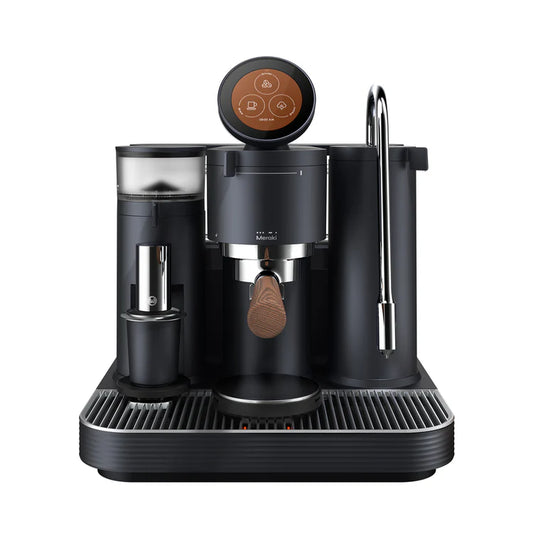
Meraki Gen 2 dual boiler espresso machine with integrated grinder at Di Pacci

Every few years a machine comes along that rewrites what people expect at a given price. The Meraki espresso machine is one of those. A dual boiler, a commercial rotary pump, an integrated grinder, and two built-in gravimetric scales — all in one footprint, for under the price of a mid-tier prosumer setup. On paper it reads like a wish list. The question every home barista actually wants answered is simpler: does it pull a good shot, and does it hold up? Here is our honest take.

The short version: The Meraki packs a genuine dual boiler, rotary pump, dual gravimetric scales, and a Timemore-built grinder into one all-in-one body. It excels at workflow and milk steaming, and the weight-based dosing is a real advantage over timer-based machines. The trade-offs are no flow control, no pressure read-out, and a young brand with longevity yet to be proven. For push-button precision without buying a separate grinder, scale, and machine, it is one of the most compelling all-in-ones we have seen.

What Is the Meraki Espresso Machine?

The Meraki is a semi-automatic, all-in-one dual boiler espresso machine built around three cylindrical towers: the grinder on the left, the brew boiler and group in the middle, and the steam boiler on the right. A circular touchscreen sits on top, with physical paddle switches on the brew and steam towers so you can operate them without the screen.

"Meraki" is a Greek word that means doing something with soul and passion. The brand itself is a Chinese company based in Shenzhen, and the machine spent more than two years in development before its Kickstarter campaign — which funded to roughly two million dollars — brought it to production. What sets it apart from almost every other machine at this price is its dual gravimetric system: one scale under the grinder weighs your dose as it grinds, and a second scale under the group head weighs your shot as it pours.

Key Specifications

TypeSemi-automatic, all-in-one dual boiler
Boilers350ml brew + 550ml steam, stainless steel
PumpCommercial-grade rotary pump, 9 bar
Temperature controlThree PIDs — brew boiler, steam boiler, group head
GrinderTimemore-built 37mm conical, stepless, anti-static
ScalesDual gravimetric, grind-by-weight + brew-by-weight
Portafilter (Gen 2)58mm, E61-compatible
Water tank2 litres, removable
Heat-up timeAbout 2–3 minutes
Smart featuresCoffeeSense NFC bean reader, Wi-Fi firmware updates
Warranty2 years
OriginDesigned and made in China

Build and Design

The most common question people ask is about build quality, since a good portion of the body is ABS plastic. The honest answer is that this is a multi-material machine. The brew and steam boilers are stainless steel, as are the steam wand, the grinder exit chute, the brew group, and the portafilter. The drip tray and brew group casing use die-cast and anodized aluminium. The base and parts of the housing are riffled ABS plastic. In practice the parts that matter for heat and longevity are metal, and the plastic is concentrated in the cosmetic shell.

Keeping the grinder on its own separate column is a thoughtful touch. It isolates the beans from the heat and moisture of the boilers — something machines like the Breville Barista Express can't manage with their integrated top-mounted hoppers.

The Grinder

The integrated grinder is a collaboration with Timemore, a name that has earned real respect in the home grinder world. It uses a 37mm conical burr set, is stepless, and includes an encoder so the machine always knows exactly where the grind is set. There is also a de-ionizer that keeps the grounds fluffy and static-free, which makes a noticeable difference to workflow and mess.

Grinders with de-ionizers often grind slowly, but the Meraki is an exception, moving at around 1.5 grams per second. In our experience that translates to a 17-gram dose in roughly ten seconds — fast enough that it never becomes a bottleneck in your morning routine. The one limitation worth noting: the grinder can only be triggered through the screen, not by a physical button.

The Steam Wand and Milk

This is where the Meraki genuinely shines. The long gooseneck steam wand has three holes and produces some of the driest, most controllable steam we've tested at this price. A temperature probe in the head reads milk temperature live as it heats, and the machine can steam automatically — set your target temperature, position the wand, and it stops on its own.

Why dry steam matters: When a steam wand adds less water to the milk, you get denser, more stable microfoam and better-tasting drinks. In testing, the Meraki added only around 14 grams of water steaming milk to temperature — where many machines add 20 to 40 grams. That is a real quality edge for latte and flat white drinkers.

Gravimetric Dosing: The Standout Feature

The dual scales are the headline feature, and they deserve the attention. Most machines under this price use a volumetric water wheel that counts flow to estimate your shot — a method that drifts as grind, dose, and bean density change. The Meraki instead weighs the shot directly and stops at your chosen yield, accurate to a tenth of a gram, regardless of flow rate.

The convenience compounds. You never have to move and re-tare a scale between grinding and brewing because both stages have their own. Set a dose target, the grinder stops on weight. Set a yield target, the shot stops on weight. For repeatability, this is the kind of consistency that usually requires a separate Bluetooth scale and a fair bit of fiddling.

Pre-infusion, PID and What's Missing

The Meraki includes a solenoid valve to release pressure off the puck after extraction, low-pressure pre-infusion you can tune by pressure and time, and three independent PIDs for thermal stability. The smart side is rounded out by CoffeeSense, which reads an NFC chip on partnered coffee bags to auto-load grind, dose, and extraction settings, plus Wi-Fi firmware updates that can add features over time.

The notable gaps are flow control and a live pressure read-out. There is no way to manually shape flow during the shot, and you have to trust the system is holding 9 bar rather than watching a gauge. For most home baristas chasing repeatable results these won't be deal-breakers, but flow-profiling enthusiasts will feel the absence.

Gen 2 vs Gen 1: What Changed

If you're weighing a used Gen 1 against a new Gen 2, three upgrades matter. The Gen 2 moves to a 58mm E61-compatible portafilter, where the Gen 1 locked you into Meraki's own proprietary fitting — meaning you can now use bottomless portafilters and aftermarket precision baskets. It also adds a wider grinding range that reaches into filter and pour-over territory, not just espresso, and ships with an improved shower screen. Everything currently shipping is Gen 2.

How Does It Compare?

The closest all-in-one rival is the Breville Barista Touch Impress, which also bundles a grinder, screen, and a strong steam wand. But the Breville is a single boiler and uses no scales or NFC reader, where the Meraki gives you a true dual boiler and gravimetric dosing. The Breville Oracle Jet leans more toward guided simplicity with volumetric dosing, while the Meraki trades hand-holding for precision. If you want a traditional upgrade path with flow profiling, a separate grinder-and-machine combo such as a Lelit Bianca still offers more room to grow — at a higher total cost and a larger footprint.

Pros and Cons

✅ Pros

  • True dual boiler with quiet rotary pump
  • Dual gravimetric scales — accurate, repeatable dosing
  • Excellent dry steam and easy milk texturing
  • Timemore 37mm conical grinder, low static
  • Fast 2–3 minute heat-up
  • Gen 2 E61 58mm compatibility opens accessories
  • Smart CoffeeSense and Wi-Fi updates

✖ Cons

  • No flow control
  • No live pressure read-out
  • Longevity unproven — young brand
  • Grinder can only be triggered via the screen
  • No water filter included

Who Should Buy the Meraki?

The Meraki suits the home barista who wants café-level precision and pro milk steaming without assembling a separate grinder, scale, and machine — and who values weight-based consistency over manual flow profiling. If you're weighing it against a traditional setup, our machine and grinder packages are worth a look. If your priority is a tidy, repeatable, push-button workflow that still gives you real control over dose and yield, it makes a lot of sense. If you're a tinkerer who lives for pressure profiling and a decades-proven parts network, a traditional prosumer combo is still the safer long-term bet.

The Verdict

The Meraki is an inventive, genuinely impressive machine. The dual scales are a workflow game-changer, the rotary pump is pleasantly quiet, and the steam wand is among the best we've used at home. The honest caveats are the missing flow control, the lack of a pressure gauge, and a brand whose long-term reliability is still being written. For what it delivers in one compact body, though, it is one of the most compelling all-in-one dual boilers among the home espresso machines we stock — and a machine our team has had a lot of fun pulling shots on. You can buy the Meraki Gen 2 at Di Pacci, available in White or Black with a 2-year warranty and free shipping over $200.

Frequently Asked Questions

Is the Meraki a good espresso machine?

For an all-in-one under the price of most prosumer setups, yes. It offers a genuine dual boiler, a commercial rotary pump, weight-based dosing, and excellent milk steaming. The main caveats are no flow control, no pressure read-out, and a young brand with longevity still to be proven.

What grinder does the Meraki use?

A 37mm conical burr grinder co-developed with Timemore. It is stepless, has an encoder so the machine knows the exact setting, and includes a de-ionizer to keep grounds static-free. It grinds at roughly 1.5 grams per second.

What is the difference between the Meraki Gen 1 and Gen 2?

Gen 2 adds a 58mm E61-compatible portafilter (Gen 1 was proprietary), a wider grinding range that reaches filter and pour-over, and an improved shower screen. Everything shipping now is Gen 2.

Does the Meraki have dual boilers?

Yes. It uses a 350ml stainless steel brew boiler and a 550ml stainless steel steam boiler, each with its own PID control, so you can brew and steam at the same time without waiting.

Does the Meraki have flow control?

No. It includes low-pressure pre-infusion you can adjust by pressure and time, but there is no manual flow control during the shot and no live pressure gauge.

About the author — Mik Di Pacci is the Founder & CEO of Di Pacci Coffee Co., Australia's largest coffee machine specialist, operating since 2010 with showrooms across Sydney, Melbourne, Perth, Port Macquarie and Queensland. Di Pacci runs an in-house roastery and service workshop, and offers free shipping on orders over $200.


Leave a comment