Buying Guides · Commercial Coffee Machines
✍️ By Mik Di Pacci, Founder & CEO, Di Pacci Coffee Company ·

Choosing a commercial coffee machine for a small cafe comes down to matching the machine to your real daily volume, not buying the biggest unit you can afford. A 1 or 2 group machine with a heat exchanger or dual boiler, enough counter space, and the right electrical circuit will outperform an oversized 3 or 4 group machine that never gets used to capacity. The right pick depends on your peak-hour coffee count, group-head configuration, available bench space, budget, power and plumbing, and whether your grinder can keep up with the machine. Below, we compare six genuine Di Pacci commercial machines suited to small cafe service, with verified specifications and pricing.
What Is the Best Commercial Coffee Machine for a Small Cafe?
There is no single best machine for every small cafe. A 1 group machine such as the Expobar Megacrem Compact suits a low-volume setup like a waiting room or small kiosk, while a 2 group machine such as the CREM EX3 or Nuova Simonelli Appia Life handles a steadier stream of walk-in customers without a queue forming. The right choice depends on your peak-hour order count, counter space, and whether you expect to grow into a second barista station.
Best Commercial Coffee Machines for Small Cafes – Quick Comparison
| Image |
Machine |
Group Heads |
Best For |
AUD Price |
View Product |
 |
Expobar Megacrem 1 Group High Cup Compact |
1 Group |
Kiosks & low-volume cafes |
$4,095.00 |
View product |
 |
1 Group Ruggero Classic High Group Compact |
1 Group |
Waiting rooms & small client-facing setups |
From $5,300.00 |
View product |
 |
Nuova Simonelli Appia Life |
1 or 2 Group |
New cafes wanting a proven global brand |
From $5,490.00 |
View product |
 |
Expobar 2 Group MegaCrem High Group Compact |
2 Group |
Steady walk-in cafes on a tighter budget |
$5,273.00 |
View product |
 |
CREM EX3 2 Group High Group |
2 Group |
Small cafes planning to scale up service |
From $6,700.00 |
View product |
 |
Wega Pegaso |
1, 2 or 3 Group |
Medium to high-volume cafe service |
From $6,300.00 |
View product |
Pricing and availability are accurate at time of publishing and sourced directly from each product page on dipacci.com.au. Please confirm current pricing and stock before purchase, as both can change.
Top Commercial Coffee Machines for Small Cafes in Australia
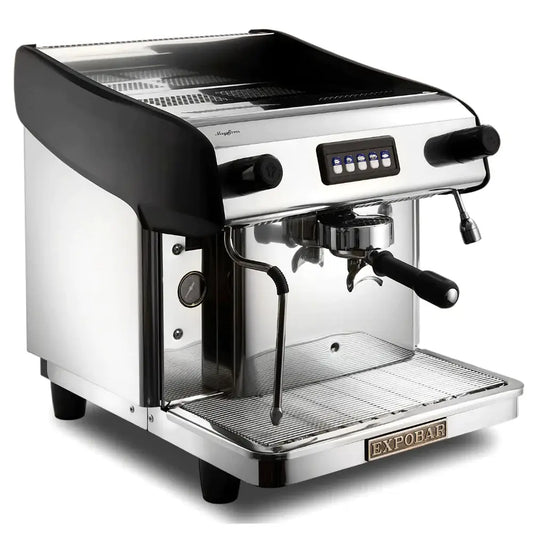
Expobar Megacrem 1 Group High Cup Compact Coffee Machine
Best for: kiosks, coffee carts and low-volume cafes
-
Group heads: 1 Group
-
Boiler: 6 litre copper heat exchanger
-
Dimensions: H51 x W48 x D58cm
-
Weight: 50kg
-
Power: 10 amp, single phase
-
Control: Programmable volumetric dosage via illuminated touch-pads
Why it is worth considering: This is the most affordable genuine commercial machine in the range, with a copper heat exchanger boiler, automatic boiler refill and a steam pressure gauge. It is a solid entry point for a cafe that does not yet need a second group head.
Potential limitations: A single group head means only one shot can be pulled at a time, so it is better suited to lower or steadier order volumes rather than a sustained rush.
Price: $4,095.00 AUD
Our verdict: A sensible starting machine for a genuinely small operation, provided daily volume stays modest.
View the Expobar Megacrem at Di Pacci
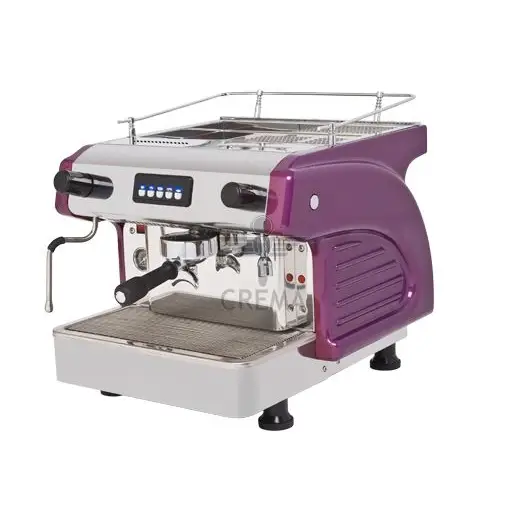
1 Group Ruggero Classic High Group Compact Coffee Machine
Best for: waiting rooms, meeting rooms and small client-facing businesses
-
Group heads: 1 Group, E61
-
Boiler: 6 litre, 99.9% pure copper, heat exchanger
-
Power: 10 amp, single phase
-
Pump: Rotary, 200 litres per hour
-
Build: Custom made to order, with colour and signage options
-
Capacity: Up to roughly 50 cups per day as stated by the manufacturer
Why it is worth considering: Hand built with volumetric electronic controls, a pure copper boiler and an included light box sign, this machine suits businesses that serve coffee to clients rather than running continuous retail service.
Potential limitations: It is pitched specifically at smaller, lower-throughput locations, so it is not the machine to choose if you expect queues to build during a morning rush.
Price: From $5,300.00 AUD
Our verdict: A good fit when branding and presentation matter as much as output.
View the Ruggero Classic at Di Pacci

Nuova Simonelli Appia Life Coffee Machine
Best for: new cafes wanting a recognised international commercial brand
-
Group heads: 1 Group ($5,490) or 2 Group Compact ($5,999)
-
Brand: Nuova Simonelli, Italy, a long-established commercial espresso manufacturer
-
Colours: White or Black
-
Design focus: Energy efficiency and consistent extraction
Why it is worth considering: Nuova Simonelli is one of the most widely used commercial espresso brands worldwide, and the Appia Life range is built for high productivity with straightforward, intuitive controls.
Potential limitations: Confirm current colour and group-head stock availability with Di Pacci before ordering, as specific configurations can sell out.
Price: From $5,490.00 AUD
Our verdict: Worth the look if brand reputation and parts availability matter to you long term.
View the Appia Life at Di Pacci

Expobar 2 Group MegaCrem High Group Compact Coffee Machine
Best for: steady walk-in cafes wanting two group heads on a tighter budget
-
Group heads: 2 Group
-
Boiler: 11.5 litre copper heat exchanger
-
Dimensions: H51 x W70 x D58cm
-
Weight: 65kg
-
Power: 20 amp, single phase
-
Control: Programmable volumetric dosage, automatic boiler refill
Why it is worth considering: This is the most affordable genuine 2 group commercial machine in the range, letting two baristas or two orders run in parallel without a large price jump from the 1 group models.
Potential limitations: The 20 amp power requirement needs to be checked against your existing circuit before installation.
Price: $5,273.00 AUD
Our verdict: The strongest value pick for a small cafe stepping up to two group heads.
View the Expobar 2 Group Compact at Di Pacci
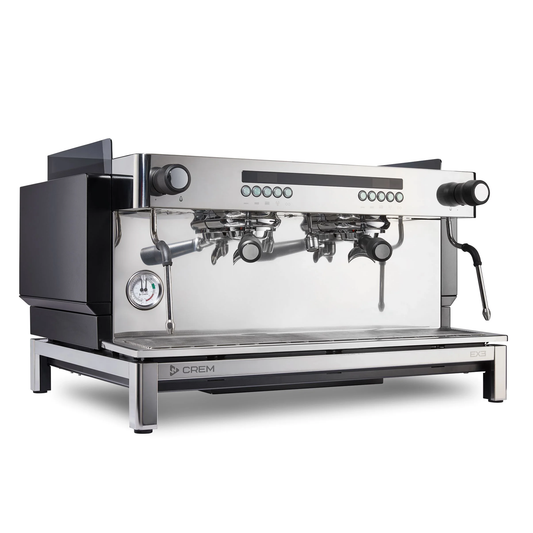
CREM EX3 2 Group High Group Coffee Machine
Best for: small cafes that expect to scale up service over time
-
Group heads: 2 Group, high group configuration
-
Boiler: 11.5 litre, 99.9% pure copper, automatic filling
-
Heating element: 3050 watts standard (4500 watt upgrade available)
-
Power: 15 amp standard (20 amp with element upgrade)
-
Dimensions: 77cm W x 58cm D x 46cm H, 60kg
-
Steam: 2 outlets, each with its own pressure gauge
Why it is worth considering: The EX3 is genuinely modular. Bar pressure, water flow speed and temperature can all be tuned, and the high group clearance suits tall takeaway cups. It is sold directly by the manufacturer as suitable for both a small cafe and busier service.
Potential limitations: The standard element draws 15 amps, rising to 20 amps if the higher-wattage upgrade is selected, so confirm your circuit capacity first.
Price: From $6,700.00 AUD (was $7,370.00)
Our verdict: Our pick for a small cafe that wants room to grow without replacing the machine later.
View the CREM EX3 at Di Pacci
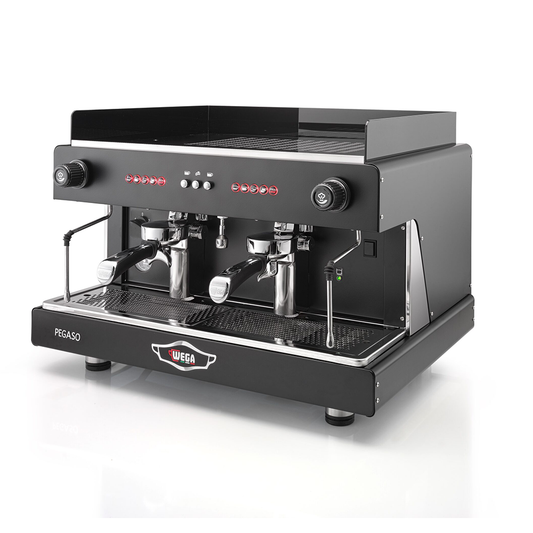
Wega Pegaso Commercial Coffee Machine
Best for: cafes expecting medium to high daily volume
-
Group heads: 1 Group ($6,300), 2 Group ($7,200) or 3 Group ($9,400)
-
Boiler (2 Group): 17 litres, dimensions H53 x W98 x D54cm, 82kg
-
Power (2 Group): 25 amp
-
Features: Four programmable doses per group, manual brewing button, 2 steam wands, automatic water fill
-
Colours: Black or White
Why it is worth considering: Wega is a well-established Italian commercial brand, and the Pegaso's high group clearance and dual steam wands make it genuinely suited to a cafe with two people working the machine during busy periods.
Potential limitations: At 25 amps and 82kg for the 2 group model, it needs a dedicated circuit and solid bench support, so it is a step up from the lighter 1 group entry machines above.
Price: From $6,300.00 AUD
Our verdict: Choose this if you are confident volume will justify the extra investment from day one.
View the Wega Pegaso at Di Pacci
1-Group vs 2-Group Commercial Coffee Machines
| Factor |
1 Group |
2 Group |
| Peak-hour workflow |
One shot at a time, fine for a steady trickle of orders |
Two shots can run in parallel, smoothing out short rushes |
| Counter space |
Smallest footprint, roughly 48cm wide |
Wider footprint, typically 70 to 98cm depending on model |
| Steam capacity |
Usually one steam wand |
Often two steam wands for simultaneous milk jobs |
| Purchase price |
Generally the lower starting price in a range |
Usually several hundred to over a thousand dollars more |
| Staff requirements |
Comfortable for one barista |
Supports one or two baristas working together |
| Expected business growth |
Suits a stable, low daily volume |
Gives headroom if customer numbers grow |
We cannot state a fixed number of cups per hour for any machine, since real output depends on your grinder, barista speed, drink style and how consistently the machine is maintained. Use the comparison above to match the configuration to your own expected service pattern rather than a specific cups-per-hour claim.
How Much Does a Commercial Coffee Machine Cost in Australia?
Based on the Di Pacci range reviewed above, genuine new commercial espresso machines suited to a small cafe start from around $4,095 for a 1 group model and run through to roughly $7,200 for a well-specified 2 group machine, with 3 group machines moving into the $9,000 plus range. Beyond the machine itself, budget for:
-
Commercial grinder: a dedicated commercial grinder is essential and is a separate purchase from the machine.
-
Water filtration: protects the boiler from scale and extends service intervals.
-
Installation: Di Pacci offers free commercial machine installation for Sydney metro areas, with charges applying outside metro or interstate.
-
Maintenance and servicing: Di Pacci's in-house service team handles repairs, servicing and rebuilds for commercial machines.
-
New versus refurbished: a serviced second-hand machine can reduce upfront cost significantly if budget is the main constraint.
How to Choose the Right Coffee Machine for Your Small Cafe
- Estimate your daily and peak-hour coffee volume before comparing machines.
- Choose a 1 group configuration for lower volume, or 2 group if you expect a steady rush.
- Measure your counter space and confirm the machine's footprint and depth will fit.
- Check your electrical supply, since commercial machines commonly need a 10, 15, 20 or 25 amp circuit.
- Confirm your water connection, as most commercial machines are plumbed in rather than tank fed.
- Assess milk steaming needs, including whether you need one or two steam wands.
- Match the machine with a commercial grinder rated for the same daily volume.
- Factor in service and maintenance support, and plan ahead for future growth.
New vs Refurbished Commercial Coffee Machines
New machines
A new machine comes with a full 12 to 24 month manufacturer warranty, the latest components, and no unknown service history. It is the lower-risk choice for a first cafe, though it carries the highest upfront cost.
Refurbished machines
Di Pacci's second-hand commercial range includes ex-cafe machines that have been inspected, serviced and backed by a 3-month parts warranty, offering genuine cost savings for a budget-conscious fit-out or a backup machine.
Browse Di Pacci's second-hand commercial coffee machines
Should a Small Cafe Buy, Rent or Finance a Coffee Machine?
Di Pacci offers coffee machine hire and rental for both small and fully equipped commercial units, alongside finance options for businesses that prefer to spread the cost of a new machine rather than paying upfront. Outright purchase suits cafes with available capital and a clear long-term plan, rental suits short-term or trial setups such as pop-ups and coffee carts, and finance can help a new cafe secure a higher-specification machine sooner. We are not able to state specific finance rates, repayment terms or rental pricing here, as these depend on your individual application.
View Di Pacci finance options
Essential Coffee Equipment for a Small Cafe
A commercial espresso machine is only part of the setup. A small cafe also typically needs a commercial coffee grinder matched to the machine's output, precision tools such as tampers and scales from the precision coffee accessories range, a knock box, milk pitchers, a water filtration system, cleaning products, and quality coffee beans. If you are new to the equipment side of running a cafe, Di Pacci's barista training courses cover machine operation and milk texturing for staff who are new to commercial equipment.
Common Mistakes When Buying a Commercial Coffee Machine
- Choosing a machine on price alone, without checking it suits your actual volume.
- Underestimating peak-hour demand and ending up with one group head when two are needed.
- Ignoring power requirements and discovering the circuit cannot support the machine after delivery.
- Pairing a good machine with an underpowered or mismatched grinder.
- Overlooking water quality and skipping filtration, which shortens boiler life.
- Forgetting installation costs, particularly outside Sydney metro areas.
- Ignoring after-sales support and warranty terms when comparing machines.
- Failing to plan for growth, then needing to replace the machine within a year or two.
Frequently Asked Questions
What is the best commercial coffee machine for a small cafe?
It depends on your volume and budget. A 1 group machine such as the Expobar Megacrem Compact suits lower volume, while a 2 group machine such as the CREM EX3 or Expobar 2 Group MegaCrem Compact suits a steadier flow of walk-in customers.
How much does a commercial coffee machine cost in Australia?
Based on the verified Di Pacci range above, genuine new commercial machines start from around $4,095 for a 1 group model, with 2 group machines typically ranging from roughly $5,273 to $7,200 depending on brand and configuration.
Is a 1 group espresso machine enough for a cafe?
A 1 group machine can be enough for a cafe with steady, lower daily volume, such as a kiosk or a business serving coffee to clients rather than continuous retail traffic.
Is a 2 group coffee machine suitable for a small cafe?
Yes. A 2 group machine is a common choice for a small cafe expecting a regular stream of customers, since it allows two shots to be pulled at once during busier periods.
What coffee machine do professional baristas use?
Professional baristas commonly work on established commercial brands such as Nuova Simonelli, Wega, La Marzocco and CREM, all of which Di Pacci stocks in configurations suited to cafes of different sizes.
Can I use a home espresso machine in a cafe?
Home machines are not built for continuous commercial service, lack the boiler capacity and duty cycle of commercial units, and are not a suitable substitute for a genuine commercial espresso machine in a trading cafe.
Should I buy a new or refurbished commercial machine?
A new machine offers a full manufacturer warranty and no unknown history, while a serviced refurbished machine from Di Pacci's second-hand range can meaningfully reduce upfront cost for a budget-conscious fit-out.
What equipment do I need to start a small cafe?
Alongside the espresso machine, you will typically need a commercial grinder, water filtration, a knock box, tampers and scales, milk pitchers, cleaning products and coffee beans, plus barista training if staff are new to commercial equipment.
Final Verdict – Best Coffee Machine for a Small Cafe
If budget is the main constraint and volume is genuinely low, the Expobar Megacrem 1 Group High Cup Compact at $4,095 is the most accessible genuine commercial starting point. If you expect a steady stream of walk-in customers and want room to grow, the CREM EX3 2 Group High Group at $6,700 offers the best balance of configurability, build quality and price among the 2 group options reviewed here. For cafes anticipating higher volume from day one, the Wega Pegaso 2 Group is the stronger long-term investment. Whichever machine you choose, confirm current pricing, stock and electrical requirements directly with Di Pacci before ordering, and pair it with a matched commercial grinder for consistent results.